

Shaun Murison
Senior Analyst, Rand Swiss
Shaun is a senior analyst specialising in derivatives trading and technical analysis across index, commodity, FX, and equity markets. With nearly 20 years of experience in financial markets, Shaun brings deep expertise to his role, presenting research and analysis to Rand Swiss clients. Shaun is a regular commentator on local and global financial markets, contributing to major media outlets including CNBC Africa, Reuters, Moneyweb, and Business Day. He produces daily and weekly market reports focused on technical analysis and trading opportunities in his core markets. As a registered person at the JSE and a Certified Financial Technician (CFTE), Shaun combines formal credentials with practical market expertise.
You can follow Shaun on Twitter at @ShaunMurison_RS for regular market updates and trading insights.
Share
Is the South African rand set for further gains?
The South African rand has delivered an impressive performance in 2025, posting double-digit returns year-to-date and significantly outperforming competing emerging market currencies. This remarkable appreciation has caught the attention of international investors and traders seeking to understand whether the rand’s strength is sustainable or merely a cyclical phenomenon driven by temporary market conditions.
Why the rand is strengthening in 2025
1. US dollar weakness: The primary catalyst
The most significant driver of rand appreciation is weakness in the US dollar itself. The Federal Reserve is signalling aggressive interest rate cuts in response to economic uncertainty, with market participants pricing in an 80% probability of a rate cut at the December 10 Federal Open Market Committee (FOMC) meeting—up dramatically from just 35% one week prior.
This shift reflects genuine concerns about US economic conditions. The unemployment rate has climbed to 4.4% from 4.3%, services sector activity has contracted, and recent payroll data surprised to the upside. When the Federal Reserve cuts interest rates, the US dollar typically weakens against emerging market currencies like the rand, benefiting South African exporters and attracting international capital flows.
2. Reserve bank credibility: A counterintuitive strength signal
On November 21, 2025, the South African Reserve Bank (SARB) cut interest rates by 25 basis points—and the rand strengthened rather than weakened. This counterintuitive currency movement reveals what truly matters to global investors: central bank credibility.
The rate cut was accompanied by a crucial policy announcement: a new, stricter 3% inflation target, down from the previous 3-6% range. Governor Lesetja Kganyago emphasized that 3% is the focal point, not merely the lower bound of a band. This represents structural policy reform backed by genuine commitment to price stability, not panic easing.
International investors have responded positively. A central bank that prioritizes inflation control rebuilds trust and attracts capital. The SARB’s forecast of inflation declining to 3.3% in 2025, combined with the measured approach to future rate cuts (March 2026 and July 2026), signals the kind of predictable policy framework that currency markets reward.
3. The carry trade: An attractive interest rate differential
- 2.75-3.00% higher than the US Federal Reserve (3.75-4.00%)
- 3.50% higher than the European Central Bank (3.25%)
- 2.25% higher than the Bank of England (4.50%)
For international investors, this mathematics is straightforward: borrow US dollars at approximately 4% and invest in South African assets yielding 6.75%, capturing a 2.75% spread. In today’s low-return global environment, this carry trade opportunity attracts genuine capital flows into rand-denominated assets, supporting currency appreciation.
4. Commodity strength: Structural support for the rand
Gold prices have experienced a dramatic surge to well over $4,000 per ounce, from $2,639 at the start of 2025. This rally reflects multiple powerful tailwinds: geopolitical tensions between Japan and China, Middle East instability, robust central bank gold buying, Fed easing expectations that reduce the appeal of the US dollar, Trump tariff uncertainty driving safe-haven demand, and substantial institutional investment flows.
As the world’s largest platinum producer and a major global gold producer, South Africa benefits directly from higher commodity prices. Mining sector profits surge, government tax revenues increase, employment prospects improve, and South Africa’s overall terms of trade strengthen dramatically. Notably, South Africa’s commodity portfolio has outperformed traditional commodity currencies as gold and platinum rank among the strongest commodities globally this year.
What could derail rand strength?
The GDP growth problem
Despite improved monetary policy credibility and commodity strength, South Africa’s economy still isn’t growing fast enough. Rate cuts alone cannot force faster economic growth. The country faces entrenched structural challenges: rising government debt-to-GDP ratios, weak private sector investment response to rate cuts, labour market rigidities that hinder job creation, and infrastructure constraints that limit productive capacity. The rand’s appreciation has a ceiling that structural economic weakness will eventually enforce.
Credit rating risk
Moody’s sovereign credit rating review on December 5, 2025, presents downside risk. While Moody’s acknowledged improved revenue gains and the lower inflation target, they warned that “tough spending choices persist.” A decision not to upgrade would disappoint markets where an upgrade appears already priced in. Fitch’s upcoming review adds additional uncertainty although the official date of their review is not yet disclosed.
The gold paradox
Geopolitical crises that drive gold prices higher simultaneously trigger selling in emerging market assets, including the rand. South Africa achieves maximum benefit when commodity strength stems from genuine global demand rather than crisis-driven flight to safety. Right now, some gold strength reflects geopolitical fear, creating offsetting pressures on the currency.
The verdict: A cyclical currency with limited upside
The rand’s 2025 strength is real and driven by credible SARB policy, attractive rate differentials, and legitimate commodity support. However, appreciation remains capped by structural growth constraints and vulnerable to credit rating downgrades. Treat rand exposure as a cyclical play on emerging market sentiment and carry trade demand, not a structural long-term investment story.
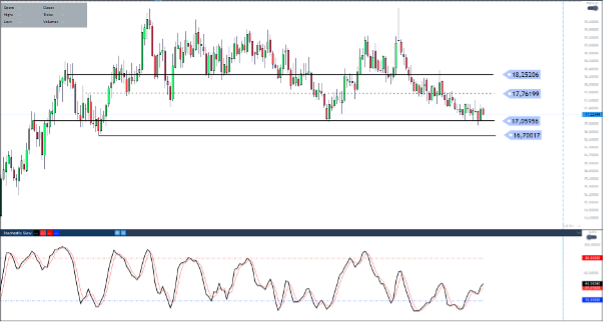
USD/ZAR – technical view (weekly chart)
A weekly chart of the USD/ZAR shows a broad, long-term range-bound price environment. Currently, the USD/ZAR sits at the lower end of that range.
Support levels for the currency pair currently sit at R17.05/$ and R16.70/$, which provide downside targets should we continue to see rand strength/dollar weakness.
We have, however, seen a bullish price reversal off the R17.05/$ support level, accompanied by a move out of oversold territory. Provided that the R16.70/$ level is maintained, this suggests that over the short to medium term, a move towards the R17.70/$ level may be favoured by traders. Traders who are long into this implied move might consider using a close below the R16.70/$ level as a stop loss indication.
If you intend to utilise any portion of your remaining R1 million Single Discretionary Allowance (SDA) for the year, now may be the optimal time to do so. Unused allocations expire on 31 December, and with most service providers closing offshore transfer instructions ahead of the Christmas period, the available window is rapidly narrowing. Email [email protected] or call us on 781-4454 now, and we’ll help you secure your transfer before the cut-off.
Stay ahead of the markets
Our analysts work around the clock to bring you clear, contextual insights on global financial trends — helping you spot opportunities and make confident investment decisions.
Get expert perspectives on the markets, the economy, investing, trading, and wealth planning with our free email newsletters—customised to your interests.
Subscribe today and receive our complimentary market and trading insights straight to your inbox.